A harness for coding agents
Your agents say it’s done. Is it?
Agents propose. You rule. Tests prove. And every call has a name on it.
It is not a model. It is a harness your agents connect to, and it keeps your fleet of agents in check and on target: the rules you ruled, what you asked for in your own words, and whether the work is done — its commits found on your default branch, a passing test on every claim it was built to make true and a person’s yes that the work looks right. A person’s no outranks the test, and the agent’s word counts for nothing.
Claude Code, the Claude app, Codex or Gemini CLI
law · claims · commissions · backlog · ideas · bugs
in the web app at app.mechaneion.com
in your own repository
or by a step in your checks.
Mechaneion never asks for access to the repository.
Counted off our own board
Mechaneion itself, and the game it was built for: commits on their default branches, and how our own board stands — the claims a test holds, out of all the claims we make, and the rules in force. Nothing here is typed into this page and nothing is kept here: the page asks, and draws the answer.
These are read from Mechaneion when the page opens, which needs JavaScript. With it off, there are none here.
Sequential is safe. Parallel is fast. You’ve been told to pick one.
You can build something genuinely good one session at a time. Keep it in front of you, answer every question the moment it arrives, never let it guess. It works. It also takes as long as it takes, and that’s longer than you have — you’d be babysitting a single session for months to get what a fleet does in a week.
So you run five agents and get the other failure. Five contexts, five sets of assumptions, nobody holding the whole thing, and work that reads as finished because the agent that wrote it says it is.
Mechaneion is the pipeline with the interlocks left in. The agents run at once, and when one reaches a decision only you can make, it stalls instead of guessing — writes the question down, carries on with what it can do without you, and the question waits where you’ll see it with the control to answer it sitting next to it. You answer when you sit down. The answer goes back to whichever agent was stuck on it.
Parallel agents with the safety, rather than parallel agents with the optimism.
Same request, two agents
Built for projects too big for one session: the more rules you have, the more this matters.
An example project. What the agent says to you is an example; the indented lines are the server’s real answers, and […] marks a cut.
The first time you ask.
> Add password reset.
Reads your CLAUDE.md: how to run the tests, and nothing about resets.
Asks you nothing: nothing it read says there is anything to decide.
Plans the work in this conversation, and the plan goes when the conversation does.
Writes the reset flow and commits it: a form, a token, and an email with a link.
Runs your tests, and they pass.
Done — all tests pass.
Its word is the status.
Nobody is asked; you find out when somebody tries it.
You look for yourself: nothing records whether the work reached main.
What nobody checked: the link keeps working after it’s used, and the form says “No account with that email”, which tells anyone which addresses have an account. The agent did what it was asked, and nobody asked you.
> Add password reset.
It reads the law: nothing covers resets yet.
It asks before it builds.
How long should a reset link work? I suggest one hour: long enough to find the email, short enough that an old one is useless.
Should the form ever say whether an address has an account? I suggest never: it tells a stranger who has signed up.
And the claim this work will make true, for a person to check once it is built: “If you forget your password, you can set a new one from a link sent to your email.”
> Yes to all three.
It writes them as RESET 1.1 and RESET 1.2, once you have seen their exact words.
Write 2 new rules into book RESET […] Write all of this?
That’s the prep: it happens as you ask, scoped to the work, once.
Opens the work, quoting you.
Opened commission “Add password reset” […]
Writes the flow, and every commit of it carries the task’s line.
End every commit message of this task’s work with this line […]
Runs your tests. Two of them are the rules — a used link is refused, and an unknown address gets the same answer as a known one — and a third holds the claim.
Says it has pushed to main.
The board reads it as REPORTED PUSHED […] It is NOT landed […]
The work waits for a person to say whether it works.
If you forget your password, you can set a new one from a link sent to your email.
Does it work? Yes. You say it works.
Its commit is found on main, a passing test holds the claim and a person said yes. Once you say yes to “Does the work look right?”, the commission is finished.
Commission “Add password reset” […] is finished: every task is in and what it serves says so. […]
Months later, you change your mind.
> Make reset links last a day — people keep complaining.
Sure — changed to 24 hours.
The code says a day now, and why goes when the conversation does.
> Make reset links last a day — people keep complaining.
It quotes the rule this contradicts, and asks.
That contradicts RESET 1.1 · A reset link works once and expires after an hour. Strike it, amend it, or keep it?
> Amend it: a day.
It changes RESET 1.1 once you have seen its new words, then builds.
Change what a rule says — RESET 1.1 […] Write this change?
It keeps your agents on track, and it keeps you honest.
The agent is the same in both panes: the same model, the same repository, the same tests. Mechaneion changes what it asks you before it builds, and what counts as finished.
Mechaneion runs on Mechaneion
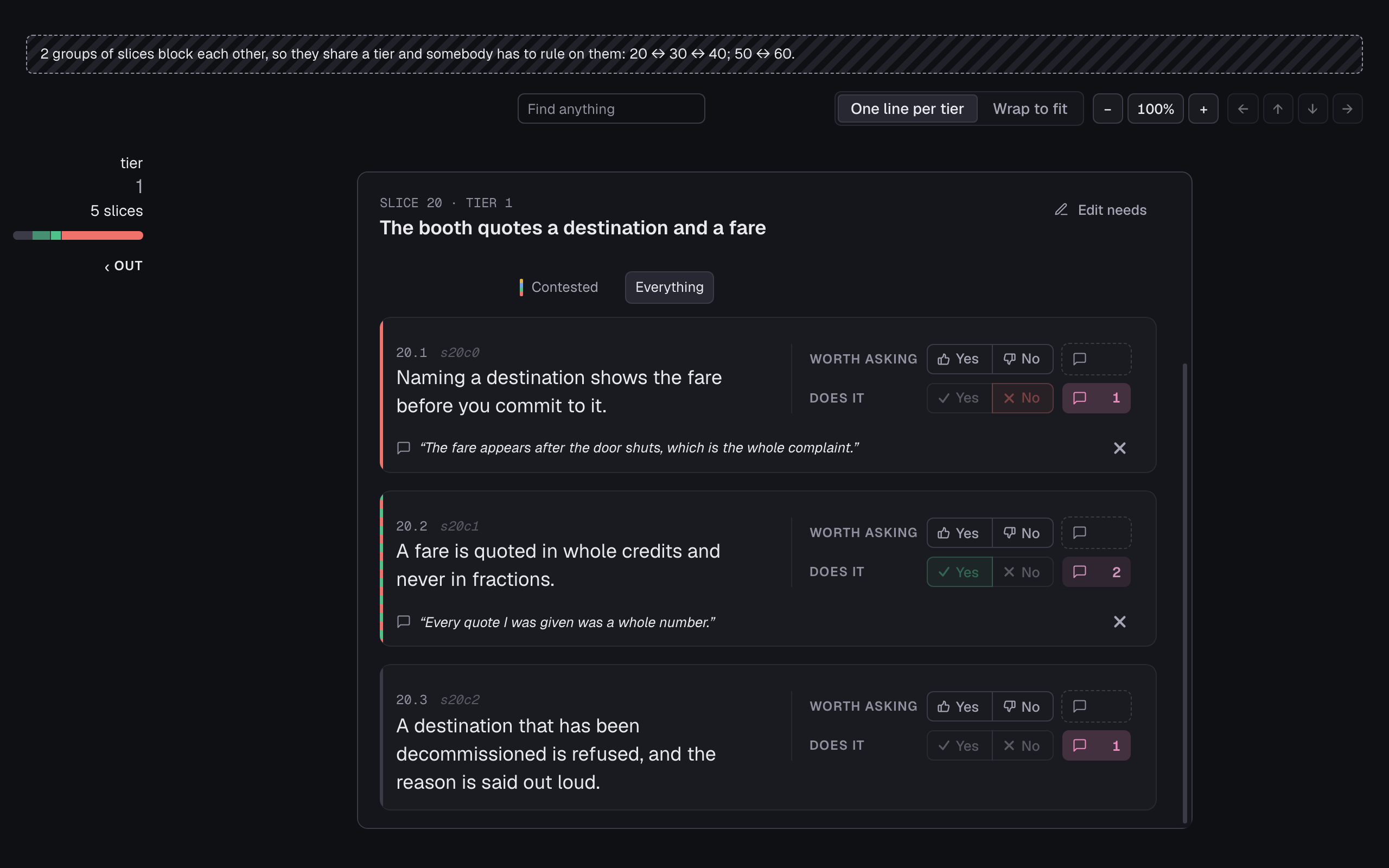
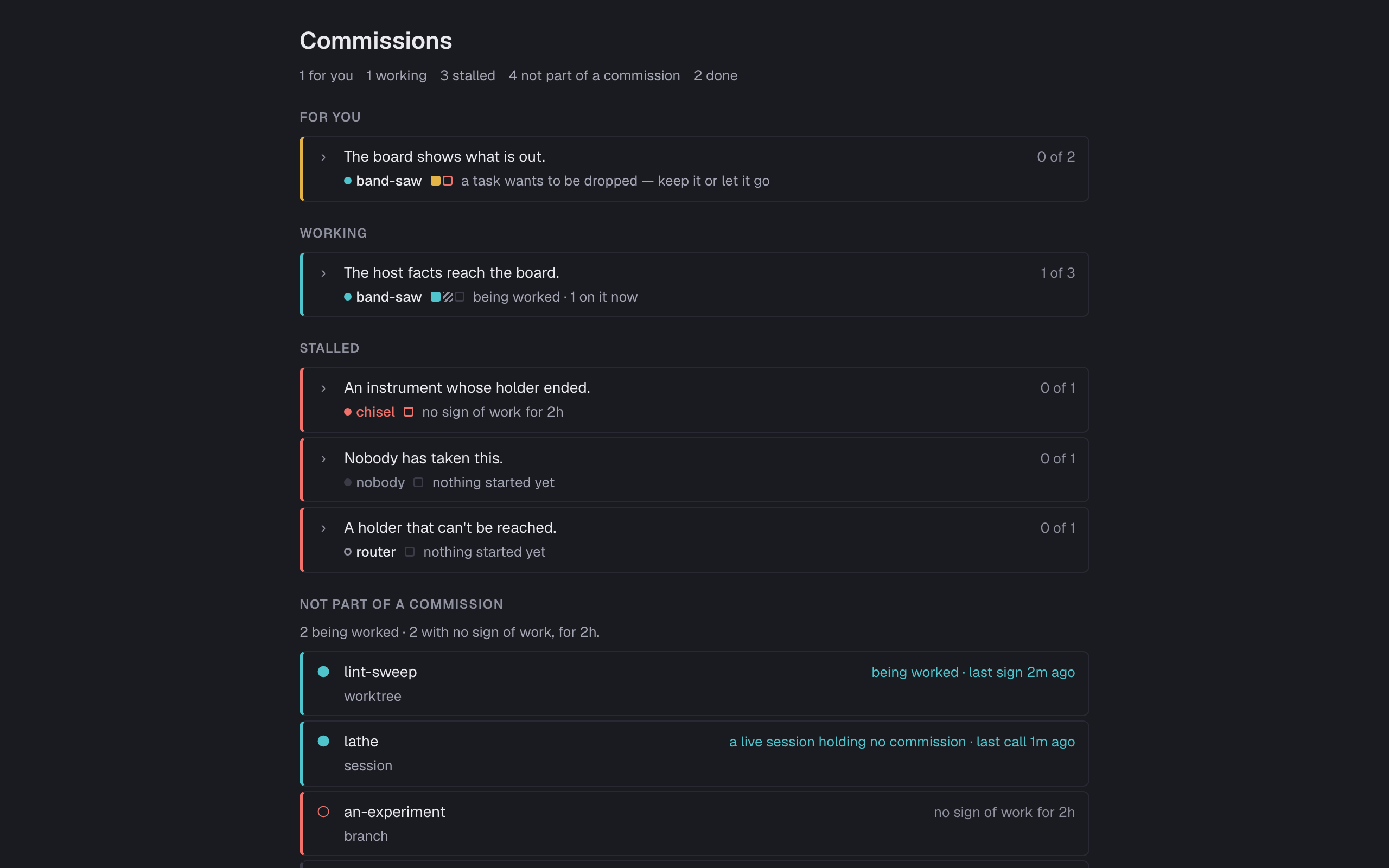
And this is ours. Not a recording: the real app, over Mechaneion’s own records, frozen at a moment.
Open Mechaneion’s own boardFour commissions, fifteen claims and ten rules across five books, exactly as they stood when they were read on 15 October 2026. You arrive signed in as a visitor and every control is live, so press anything you like: nothing you press is recorded anywhere, and reloading the page puts it all back. Opens demo.mechaneion.com in a new tab.
What it keeps
In a store beside your repository rather than in it.
Law
The rules your product obeys, in words you would say out loud. You rule them; agents read them through their own tools, and each claim names the rules it rests on. Every piece of work leaves its rules behind, and later work that touches them picks them up.
For exampleA reset link works once and expires after an hour.
Claims
One plain sentence each, about what the product does for a person. Agents propose them, and only a person can say one is worth asking. A passing test proves the product does it, a person can check it by hand, and a person’s no outranks the test; what reads as green is a bar you set.
For exampleIf you forget your password, you can set a new one from a link sent to your email.
Commissions
What you asked for, in your own words, and who is holding it. Nobody drags a card: a piece of work reads as landed because something looked at your default branch and found its commit, or, when the work was only records, because the store holds them.
For example“Add password reset”, kept as you said it, and held by the session doing it, which keeps it after its work lands.
Backlog
Work worth doing that nobody has said to start, each item saying what it is for. Nobody works it until you say go, and then it becomes a commission.
For example“Ask for a new link from the page that says yours has expired”, with the claim it would make true, waiting for your go.
Ideas
What somebody thought before it was a claim, kept in their words. Writing one down starts nothing, and working it through with an agent ends in new work, or in nothing to build, with your reason kept.
For exampleMaybe the reset email should say which device asked for it.
Bugs
What went wrong, in the words of whoever hit it. Filing a bug costs nothing and starts nothing, so reporting a defect never commits anybody to fixing it.
For exampleThe reset email arrives, and its link opens a page saying the token has already been used.
Start
Use it free for 30 days. After that nothing is locked or deleted: you can still see and download everything, but nothing new can be written until you email hello@mechaneion.com to keep going.
-
Sign in with GitHub, Google or Microsoft, at app.mechaneion.com.
-
Make your first project. You’ll be its first person, and you’ll run the project.
-
Connect your agent. In Claude Code, install the Mechaneion plugin:
claude plugin install mechaneion --marketplace Mechaneion/claude-plugin --scope userThen run
/mcpin a clone of your repository, chooseplugin:mechaneion:mechaneionand Authenticate, and your browser asks which of your projects the repository is for. For the Claude app, Codex or Gemini CLI, Settings → Your agent, in your account menu at the top right of the app, has the line for each.